&geometry(249x85) "Vet Cross")

Paralysis Ticks: How to Protect Your Dog and Cat
Ticks are more than just an unpleasant nuisance for our pets. Some species can cause serious illness, and the Australian paralysis tick (Ixodes holocyclus) can cause life-threatening paralysis in dogs and cats.
Here in Queensland, pet owners may encounter several different types of ticks, including brown dog ticks, cattle ticks and paralysis ticks. The level of risk varies depending on where you live and where your pet spends time, particularly if they regularly travel to bushy, rural or coastal areas.
The good news is that there are a range of tick prevention options available for dogs and cats. However, even pets receiving regular tick prevention should still be checked for ticks regularly.
Know your ticks
Several species of ticks can be encountered in Queensland, and they can affect animals in different ways. Knowing which ticks to be aware of can help you understand the risks to your pet.
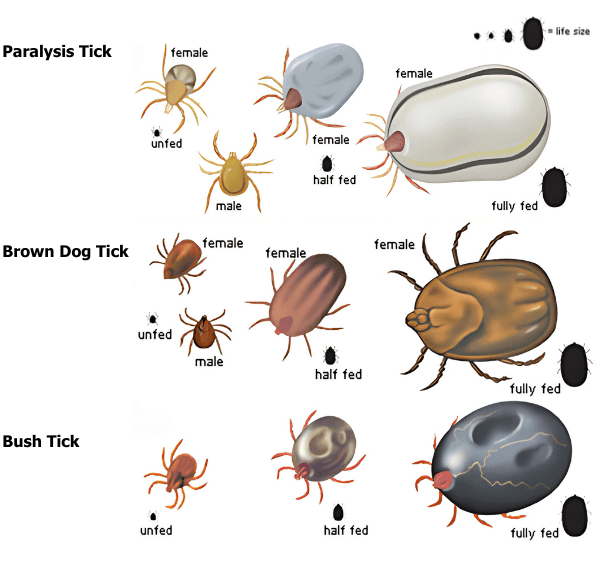
Paralysis Tick
Ixodes holocyclus
The paralysis tick is particularly important for dog and cat owners because it can produce a toxin that causes potentially life-threatening tick paralysis. Paralysis ticks are more commonly associated with bushland and coastal areas, and pets travelling into tick-prone areas may be at risk.
Brown Dog Tick
Rhipicephalus sanguineus
As its name suggests, the brown dog tick is commonly associated with dogs. It can also transmit diseases, including canine ehrlichiosis, making tick prevention important even when paralysis ticks aren't the primary concern.
Cattle Tick
Rhipicephalus australis
Cattle ticks are primarily a livestock parasite and are an important biosecurity concern in Queensland. They are particularly relevant for pets living on or visiting rural properties where livestock are present.
Important: Ticks can vary considerably in size and appearance depending on their species, life stage and whether they have fed. If you find a tick on your pet and are unsure what type it is, don't rely on appearance alone — remove it promptly and seek veterinary advice if your pet is unwell.
Why are paralysis ticks dangerous?
The paralysis tick (Ixodes holocyclus) produces a toxin that can affect the nervous system of dogs and cats. As the toxin takes effect, affected animals can develop progressive weakness and paralysis.
Thousands of dogs and cats present to veterinary hospitals with signs of tick paralysis each year. A recent Australian study involving more than 10,000 veterinary consultations highlights just how important early detection and removal can be.
A tick can be very small and may be difficult to find, particularly in pets with thick or long coats.
The sooner a tick is found and removed, the better.
Where should you look for paralysis ticks?
One of the most useful things you can learn is where to search for ticks.
A 2025 Australian study analysed 10,311 cases of tick infestation in dogs and cats and identified more than 10,000 tick attachment sites. It found that ticks commonly attach around the head, neck and ears, although they can also be found in less obvious locations.
In dogs, the head, neck and ears accounted for a large proportion of tick attachment sites. In cats, the neck was the most common location.
When checking your pet, pay particular attention to:
- Around the head and face
- Around and inside the ears
- The neck and under the collar
- Around the shoulders
- The chest
- Between the toes and around the limbs
- Under the tail
- Around the genital area
Don't just look — feel. Run your fingers slowly through your pet's coat, feeling for small lumps or bumps. A tick can be easier to find by touch than by sight.
Don't forget the unusual places
Paralysis ticks aren't always found in the obvious places. They can attach in areas that are difficult to see, including the ear canal, nostrils, inside the mouth and around the genital or anal area.
This is why a thorough, whole-body search is important rather than simply checking your pet's back.
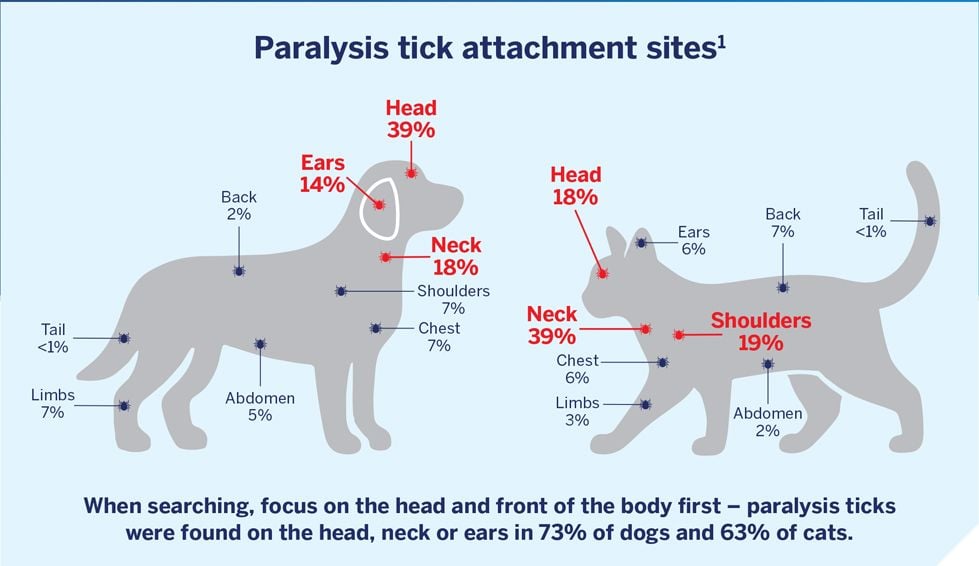
The graphic above illustrates common paralysis tick attachment sites identified in a study of more than 10,000 dogs and cats. Reproduced with permission from Boehringer Ingelheim Animal Health Australia.
Want to see how to perform a tick search?
How often should you check your pet for ticks?
If your pet lives in or travels to an area where paralysis ticks are present, daily tick searching is recommended.
Make checking your pet part of your daily routine, particularly after they have been outdoors in bushy or tick-prone areas.
Remember that finding one tick does not mean there isn't another. Carefully check the entire animal every time.
What are the signs of tick paralysis?
Tick paralysis can initially be difficult to recognise because the early signs may be subtle.
Signs can include:
- Weakness or wobbliness, particularly in the back legs
- Difficulty walking or standing
- A change in your pet's bark or meow
- Excessive salivation
- Difficulty swallowing
- Gagging or coughing
- Vomiting or regurgitation
- Difficulty breathing
- Progressive weakness or paralysis
If you notice signs that could indicate tick paralysis, contact a veterinarian immediately.
Tick paralysis can progress quickly and is a veterinary emergency.
What should you do if you find a tick?
If you find a tick on your pet, it should be removed promptly.
If your pet is showing any signs of illness or possible tick paralysis, don't delay veterinary treatment while attempting to manage the situation at home. Contact Vet Cross or an emergency veterinary service immediately.
If you are unsure how to safely search for or remove ticks, ask our veterinary team to show you how.
How can I protect my pet from ticks?
There are several tick prevention options available for dogs and cats, and there isn't one option that suits every pet.
The best choice depends on your pet's species, lifestyle, where they spend time, the parasites they are at risk of encountering and which treatment method you are most likely to use consistently.
Tick prevention for dogs
Depending on the product, tick protection for dogs is available as:
- Monthly treatments
- Longer-acting chews
- Longer-acting spot-on treatments
- Tick collars
- Long-acting veterinary-administered injections
For example, some current Australian products provide paralysis tick protection for several months from a single treatment. Bravecto Chew provides three months of flea and paralysis tick protection, while Bravecto Spot-on for Dogs provides six months of flea and paralysis tick protection.
Bravecto Quantum is another option for dogs, providing year-long flea and tick protection through a veterinary-administered injection. It is not recommended for use in cats.
Tick prevention for cats
Cats have fewer tick prevention options than dogs, and dog tick products should NEVER be used on a cat.
Current Australian options include spot-on treatments. For example, Bravecto Spot-on for Cats provides three months of flea and paralysis tick protection, while Bravecto Plus for Cats provides two months of flea, paralysis tick and heartworm protection when used at the recommended interval. NexGard Spectra is a monthly spot on for flea, tick and heartworm protection.
Your Vet Cross team can help you choose the most appropriate option for your cat based on their lifestyle and parasite risks.
Prevention doesn't replace a tick search
Even the most convenient tick prevention isn't a reason to stop checking your pet.
Tick preventatives work in different ways and no preventative can completely eliminate the risk of tick paralysis. Current product information recommends using paralysis tick prevention together with daily searching for and removal of ticks.
Think of it as two layers of protection:
Tick prevention + regular tick searching
Using an appropriate preventative helps reduce the risk, while regular searching gives you the opportunity to find and remove a tick as quickly as possible.
Which tick prevention is right for my pet?
Choosing a tick preventative isn't simply about finding the product that lasts the longest.
We can help you consider:
- Is your pet a dog or cat?
- Do they spend time outdoors?
- Do they travel to rural, bush or coastal areas?
- Do they swim regularly?
- Is giving a chew difficult?
- Would a spot-on be easier?
- Would a long-acting option help you remember treatments?
- What other parasites does your pet need protection from?
The most effective preventative is one that is appropriate for you and your pet and used correctly and consistently.
Talk to the Vet Cross team about the tick prevention options available for your dog or cat.
Don't wait until you find a tick
Paralysis ticks can be small, difficult to find and potentially deadly. Knowing how to search your pet, recognising the early warning signs and keeping your pet on an appropriate tick prevention program can all help reduce the risk.
If you're unsure whether your pet is adequately protected against ticks, speak with the Vet Cross team.
We can help you choose a tick prevention program suited to your pet's lifestyle and the risks they may encounter.
Vet Cross - helping keep your pets protected, healthy and happy.
References
Teo, E.J.M. et al. (2025). Attachment-site preferences of Ixodes holocyclus, the eastern paralysis tick of Australia: insights from 10,311 cases of tick infestations in dogs and cats. Australian Veterinary Journal, 103(11), 731-734.
Product information and registered claims should always be checked on the individual product label. Talk to your veterinarian about the most appropriate tick prevention for your pet.
Written by: Vet Cross Marketing Team
Clinically reviewed by: Dr Susan Carroll BVSc (Hons)
Last reviewed: September 2026